SPEAK FOR YOURSELF
The Linehan arrest and its implications for free speech in the UK.

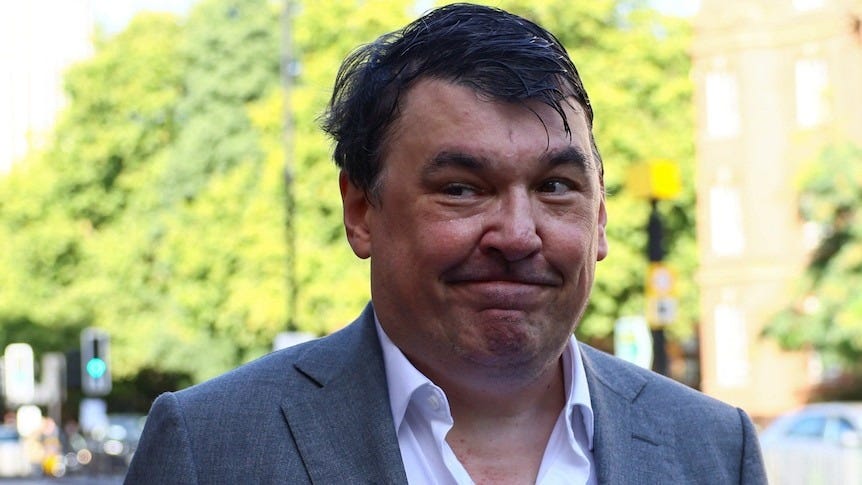
The arrest of comedy writer and gender-critical activist Graham Linehan for three posts on the social media app X, much like other headline-grabbing arrests such as those of Allison Pearson or Lucy Connolly, marks a stress test for the state of free speech in the United Kingdom. The police in the UK arrest a staggering 12,000 people a year for posts on social media, under Section 127 of the Communications Act 2003 and the Online Safety Act 2023. That works out to over 30 a day. Most of those arrests fail to result in prosecution; of those that do and who are found guilty, around a 1000 result in a fine or prison sentence of up to six months. The vast majority of those imprisoned, it is worth bearing in mind, will have harassed or threatened to rape or kill people, rather than expressed an unpleasant or offensive opinion.
These two pieces of legislation are designed to penalise "threatening", "false", and "grossly offence" communications. While "threatening" and "false" might be easier to interpret, CPS guidance sets a high bar for "grossly offensive" communications, arguing that such speech has to be more than merely shocking, disturbing, rude or unpopular before it can be considered subject to prosecution. All the same, a phrase like "grossly offensive" is nowhere near clear enough in its meaning for our current conditions. The police draw a lot of flack for some of the people they arrest, and with good reason, but they are left to enforce a sprawling and opaque tangle of laws without clear guidance as to what constitutes an arrestable offence and with wide discretionary powers. Prime Minister Keir Starmer responded to Linehan's arrest by saying "we must ensure police focus on the most serious issues", which is all well and good, but it is the government's job to write legislation, not the police. In their current state the Communications Act and Online Safety Act self-evidently pose a danger to free-expression in the UK. Linehan's arrest certainly looks like an attempt to control opinion rather than police a crime. The law needs to be urgently clarified, its definitions tightened. The line between offensive speech and criminal threats and incitement must be made less widely open to interpretation.
Many people argue our current confusions mean free speech no longer exists in the UK. Cases like Linehan's are used to bolster a narrative that we live under increasing oppression. Right-wing media like Talk TV and GB News say we live in a "police state". JK Rowling called his arrest "totalitarian". Nigel Farage compares Britain to North Korea. To put it mildly, I don't think it's quite as bad as that. Short of open incitements to violence and other exceptions (child sexual abuse material, etc), I don't think speech or opinions should be criminalised. I've always thought and argued for that. There have been many arrests in recent years for silly offences which amount, in my view, to egregious acts of state overreach, but that still doesn't compare to living in a country that lacks free speech. Those living under police states or a totalitarian regime like North Korea can only dream of possessing the freedom we have to harshly criticise arrests like Linehan's. In truth, the picture in the UK is mixed. On the one hand, there are the high-profile cases of overreach like Linehan. On the other, Nick Teconi, the current leader of UKIP, can call, in public, for the hanging of his political opponents in Parliament Square and receive absolutely no sanction whatsoever.
At the root of all this, it seems to me, is a society struggling in the wake of a communications revolution at least as important and destabilising as the invention of the printing press. We are still in the process of negotiating the boundaries of acceptable speech in the social media age. Small wonder we so often get it wrong. For all our current faults, we are still at liberty in the UK to compare Starmer to Stalin, and to argue we live in a totalitarian state, things you are not permitted to do in an actual totalitarian state. We can do so publicly, moreover, on any one of the countless platforms available to us. We can do that because, as my friend Gareth Jones pointed out to me, rather than existing in an era of narrowing free speech, the internet and social media have resulted in a veritable explosion of free speech in the 21st century. Thanks to the digital revolution, we have access to more places to express ours opinions publicly than was ever available before in human history. The amount of bandwidth available to everyone exceeds all previous communication technologies. The proverbial town square has become exponentially larger and louder. It sounds odd to say, in that context, we possessed more freedom of speech in the pre-online age.
Perhaps that sounds counterintuitive to you. If so, that might be because it is in the nature of our current media landscape to paint a picture that is dystopic. The algorithms are deranging us. We are far more likely to engage – to like, comment, share and so on – when we are angered than when not. Rage drives engagement. The algorithms respond and feed you more and more things likely to trigger you. Creators take notice and make their content more and more inflammatory and alarmist in increasingly desperate attempts to chase clicks and views. Gone are the days of sober headlines, responsible reporting, rational assessment and disinterested analysis. Social media rewards the rapid turnover of quick and instant dopamine spikes over a cool head. Our media becomes dominated by red-faced men in a state of constant catastrophising. It is all anger, all the time. Everyone rushes to the most extreme interpretation of any event. The problems we face are no longer problems, to be tackled with rational solutions, they are symptoms of the end of everything good in the world, omens of the incoming apocalypse. I'm not saying I'm immune to any of this. We are all clickbait now.
In this environment a largely peaceful anti-immigrant protest that couldn't fill a football stadium becomes a sign of an imminent "revolution" or "civil war". Asylum seekers, who make up just 4% of migrants to this country, are no longer refugees and economic migrants but an "invasion" of "terrorists" and "paedophiles" intent on replacing the white population. The Labour government is not just weak and ineffective, they have "ruined the country". Keir Starmer is not just a terrible politician, but a tyrant. Standards and laws inconsistently applied are not a sign of flawed human institutions in need of reform, but the systematic end of our cherished democratic freedoms. Everything is a sign of Britain's decline, decay and collapse. Instead of succumbing to all this sound and fury, it behoves one to maintain perspective.
I'm not arguing for complacency. Free speech cannot be taken for granted and must be fought for by every generation. Communications revolutions always prove tumultuous. The printing press led to the Reformation and centuries of religious war. Radio and television were co-opted by dictators in the age of totalitarianism. While the social media revolution has led to the Arab Spring, contributed to the rise of political populism and helped spread extremist ideologies, it hardly stands comparison to those previous epochs. The explosion in communication technology has proved a profound challenge to the noble tradition of free speech in the UK, a challenge which we have often not adequately met, for sure. Despite what the podcasting grifters of the online space would have you believe, however, our condition, for all the challenges that face us, is not that of the heretic burnt at the stake or the political dissident lined up and shot. Our liberties, though threatened by badly drawn laws and over-zealous policing, are still the envy of history.